
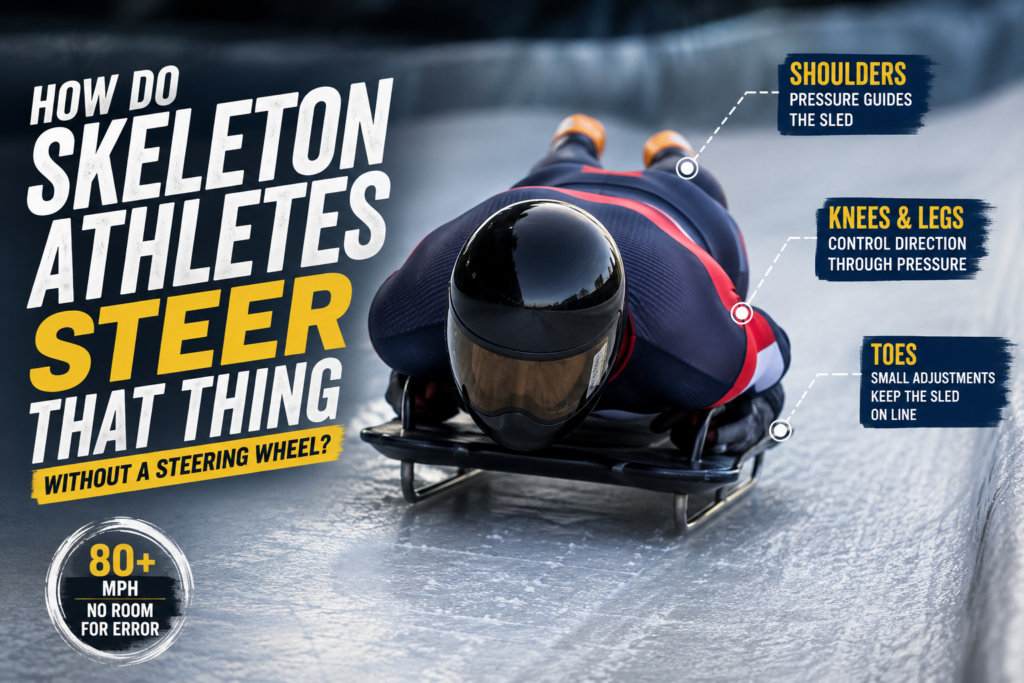
The first time you watch skeleton racing, it barely seems real. An athlete sprints across the ice, dives headfirst onto a sled that looks only slightly bigger than a cafeteria tray, and shoots down a twisting frozen track at highway speeds.
Then the obvious question hits: How do skeleton athletes steer that thing without a steering wheel?
There are no handlebars to turn, no ropes to pull, and no visible steering system. The athlete lies almost completely flat, with their arms held close to their sides and their face just inches above the ice. From the outside, it can look as though they are simply holding on and hoping the track sends them in the right direction.
That is not what is happening.
Skeleton racers control the sled through tiny, carefully timed movements of their shoulders, knees, legs, and toes. These movements change the pressure placed on the steel runners underneath the sled. The adjustments may be difficult to see, but they can determine whether an athlete glides cleanly through a curve, hits a wall, or loses a medal by a fraction of a second.
How Do Skeleton Athletes Steer That Thing Without a Steering Wheel?
Skeleton athletes steer by applying subtle pressure through different parts of their body. Pressing a shoulder, shifting pressure through a knee, or making a small movement with the toes can influence how the sled’s runners contact the ice.
The International Bobsleigh and Skeleton Federation explains that athletes steer using their shoulders, knees, and toes. Shoulder and leg movements change runner contact, which helps guide the sled in the desired direction.
The important word here is subtle. A skeleton racer is not throwing their entire body from side to side. Large movements would disturb the sled, create more friction, and make it harder to maintain a fast racing line.
Instead, athletes use movements that may be only a few millimeters. They might press one shoulder slightly harder into the sled or apply gentle pressure through one knee. At more than 80 mph, even a small adjustment can produce a noticeable change in direction. Team USA notes that skeleton athletes reach speeds above 80 mph while steering through subtle body movements.
Good skeleton steering often looks like no steering at all. The smoother the athlete’s movements are, the less likely viewers are to notice them.
Steering Is About Pressure, Not Turning
When most people think about steering, they imagine turning a wheel or moving handlebars. Skeleton sled steering works differently.
The athlete does not physically point the front of the sled in a new direction. Instead, they change the balance of pressure between the two steel runners. That pressure affects how each runner travels across the ice and helps the sled follow a slightly different path.
Think of it as guiding rather than turning. The track, gravity, momentum, and banked corners are already carrying the sled forward. The athlete makes small corrections to stay on the quickest possible route.
Those corrections need to happen at exactly the right moment. An input made too early can send the sled too high into a turn. One made too late may result in a rough exit or contact with the wall.
Why Big Movements Slow the Sled Down
Skeleton racing rewards athletes who remain calm and compact. Sudden shoulder twists, raised legs, or aggressive attempts to force the sled around a corner can create drag and friction.
A large movement can also cause the sled to skid sideways. While a sideways slide might look dramatic, it is usually slower than a clean run in which the runners continue moving smoothly along the ice.
This is why experienced athletes appear so still. Their bodies are active, but their movements are controlled. They are trying to guide the sled without fighting it.
How Does a Skeleton Sled Actually Work?
A skeleton sled is a compact piece of equipment built around a steel frame. It has a platform for the athlete’s body, handles used during the starting push, and two polished steel runners underneath.
Unlike a bobsled, a skeleton sled does not have a mechanical steering system. There are no movable front runners connected to controls. The athlete’s body effectively becomes the steering mechanism.
The sled is designed to respond to changes in pressure. When the racer presses through a shoulder, knee, or leg, the contact between the runners and the ice changes slightly. That allows the athlete to influence the sled while remaining in a low, aerodynamic position.
The Steel Runners Do More Than Slide
The runners are the only parts of the sled that remain in direct contact with the ice. Their condition, alignment, and interaction with the track have a major effect on speed and control.
During a run, the athlete tries to keep the runners moving cleanly in the direction of travel. Unnecessary corrections can cause them to scrape or slide across the ice at an angle, creating friction.
That friction may only cost a tiny amount of time, but skeleton races are often decided by hundredths of a second. A small steering mistake near the top of the track can also affect the athlete’s position in the next corner, creating problems throughout the rest of the run.
Why Skeleton Sleds Don’t Need Steering Wheels
The absence of a steering wheel is not an unfinished part of the design. It is one of the defining features of the sport.
Skeleton is built around direct interaction between the athlete, sled, and track. Racers must feel how the sled is moving through their chest, shoulders, hips, and legs. A mechanical steering system would completely change that relationship.
The simple design also makes skeleton steering a test of timing and sensitivity. Athletes need to know when to apply pressure, how much to use, and when to release it.
The Tiny Body Movements That Steer a Skeleton Sled
Television cameras can make skeleton racing look strangely peaceful. The athlete appears to be lying still while the scenery rushes past in a blur.
Look more closely, though, and there is a lot happening.
How the Shoulders Help Steer
Shoulder pressure is one of the main ways skeleton athletes guide the sled. A racer can press one shoulder slightly more firmly into the body of the sled to influence the runners.
This does not mean lifting the opposite shoulder or twisting the entire upper body. The movement is more like a controlled press through the chest and shoulder area.
Too much pressure can cause the sled to react more sharply than intended. Too little may not produce enough of a correction. Athletes develop a feel for the right amount through hundreds of training runs.
How the Knees and Legs Control Direction
The knees and legs provide another important source of control. A racer may apply pressure through one knee or adjust the position of a leg to help guide the sled through a curve.
This explains how skeleton athletes use their shoulders and knees to steer without sitting up or reaching for a control. Different tracks and corners may require different combinations of shoulder and knee pressure.
Long, sweeping turns might call for a gradual steering input. A quick transition between corners may require a shorter, more precise correction. The athlete has to make these decisions while travelling at tremendous speed.
What the Toes Do
The toes can be used for especially small adjustments. A slight toe movement can help correct the sled’s direction without forcing the athlete to disturb their overall body position.
However, racers cannot simply drag their feet whenever they want to slow down or change course. Aggressive foot contact would create friction and could make the sled unstable.
Toe inputs are therefore controlled and brief. They are part of a much larger system of body-pressure steering rather than a replacement for brakes.
Do Skeleton Athletes Steer With Their Heads?
It may look as though skeleton racers steer by moving their heads, particularly when the television angle shows the helmet tilting through a corner.
Head position matters, but it is not the main steering tool. Racers need to see where they are going while keeping their body aligned and aerodynamic. Moving the head too much can disturb that position.
The main steering inputs come from the shoulders, knees, legs, and toes. Head movement may accompany those inputs, but racers are not simply pointing their helmets in the direction they want the sled to go.
How Skeleton Racers Control the Sled at High Speed
Steering a skeleton sled is not just a matter of reacting to whatever happens next. Athletes study the track in detail before competing.
They learn the order of the corners, the shape of each turn, and the places where pressure builds. They also identify the ideal entry and exit points for every section.
By the time a racer launches from the starting line, they already have a plan for the entire run.
Choosing the Fastest Racing Line
The racing line is the path an athlete wants to follow through the track. It is not always the shortest physical distance. In many cases, the fastest route uses the shape and banking of a corner to preserve momentum.
An athlete may enter a curve from one side, rise higher on the banked wall, and then allow the sled to drop toward the exit. The exact line depends on the track, the athlete’s speed, ice conditions, and what comes immediately after the corner.
Taking the correct line reduces the need for sudden steering. When the entry is right, the sled can flow naturally through the curve.
Knowing When Not to Steer
One of the hardest skeleton skills is learning when to leave the sled alone.
Beginners may feel tempted to correct every small movement. Experienced athletes understand that constant steering creates friction and can make a run slower.
Sometimes the best decision is to remain relaxed and allow the sled to follow the track. Steering is used when necessary, not simply because the athlete feels movement underneath them.
This balance answers the question, Can skeleton racers steer, or are they just holding on? They are actively controlling the sled, but part of that control involves knowing when not to interfere.
Handling Sharp Turns Without Losing Speed
Sharp turns require preparation. Waiting until the sled is already heading in the wrong direction usually leads to a stronger correction, which costs speed.
Instead, racers begin setting up before they reach the curve. They position the sled for the correct entry and use small pressure changes as the turn develops.
A clean corner usually involves:
- Entering from the correct position
- Keeping the body low and stable
- Applying pressure gradually
- Avoiding unnecessary sideways movement
- Releasing the steering input at the right time
- Exiting in position for the next section
The goal is not merely to survive the turn. It is to leave the curve with as much speed as possible.
How Much Control Does a Skeleton Athlete Really Have?
Skeleton athletes have real control over their sleds, but they are still working within the limits of speed, gravity, momentum, and track design.
They cannot suddenly make a sharp turn as though they were driving a car. At high speed, the sled will continue moving in the general direction determined by its momentum and the shape of the ice chute.
The athlete’s job is to make precise adjustments within those limits. A shoulder press might move the sled toward a better line, but it cannot instantly erase a poor entry into a corner.
That is why mistakes often build on each other. A bad exit from one turn can leave the athlete in the wrong position for the next one. The racer may then have to steer more aggressively, creating additional friction and losing even more time.
What Happens When a Skeleton Athlete Makes the Wrong Move?
Not every steering mistake leads to a crash. More often, it leads to a slower time.
An athlete who enters a corner from the wrong position may climb too high on the wall or drop too early toward the exit. The sled might skid, bounce, or make contact with the side of the track.
Some of the most common steering mistakes in skeleton racing include:
- Steering too early
- Reacting too late
- Applying excessive shoulder pressure
- Holding a steering input for too long
- Making several unnecessary corrections
- Entering a corner from the wrong side
- Allowing the sled to skid across the ice
- Hitting a wall while exiting a turn
A wall tap may not look serious, but it interrupts the sled’s momentum. Repeated contact can turn a competitive run into a disappointing one.
Why Oversteering Is Such a Problem
Oversteering happens when an athlete makes a stronger correction than the situation requires. The sled may move too far across the track, forcing the racer to correct in the opposite direction.
That creates a back-and-forth pattern that wastes speed. Instead of travelling smoothly down the ice, the sled begins scrubbing sideways.
The fastest athletes make fewer, cleaner inputs. They steer just enough to reach the desired line and then relax the pressure.
Why Don’t Skeleton Athletes Fall Off the Sled?
A skeleton sled does not have a seat belt, enclosed cockpit, or tall sides. Even so, athletes usually remain firmly positioned on it throughout the run.
Their low body position plays a major role. The racer lies flat with the chest and torso supported by the sled. The arms remain close to the sides, while the legs extend behind the body.
The forces inside banked turns also help press the athlete into the sled. Rather than being thrown directly outward, the racer is supported by the angle of the track and their carefully maintained position.
Balance and body tension are important, but athletes do not simply grip the sled as tightly as possible. Too much stiffness can make it difficult to feel movement and respond smoothly.
The ideal position is stable but relaxed. Racers need enough control to remain connected to the sled while still being able to apply delicate steering pressure.
How Do Skeleton Racers Slow Down Without Brakes?
Skeleton sleds do not have brakes. Once an athlete starts the run, there is no normal way to stop halfway down the track.
After crossing the finish line, the sled enters an outrun area designed to reduce its speed. The track may slope upward, allowing gravity to slow the sled naturally. Fresh snow or foam pads can also be used to help bring the athlete to a stop.
This is different from bobsled, where a brake athlete can use a braking system after the team crosses the finish line. The lack of brakes means skeleton racers must commit fully once they launch onto the course.
They do not use their toes as conventional brakes during the timed run. Dragging their feet would create instability and destroy speed. Their task is to control the sled until they reach the designated stopping area.
Skeleton vs. Luge and Bobsled: How Is Steering Different?
Skeleton, luge, and bobsled all take place on icy sliding tracks, but the athletes do not control their sleds in exactly the same way.
- Skeleton racers lie face-down and travel headfirst. They steer using subtle pressure from the shoulders, knees, legs, and toes.
- Luge racers lie on their backs and travel feet-first. They also use body movements and pressure to influence the sled’s runners.
- Bobsled pilots sit inside a larger sled and use a mechanical control system connected to movable front runners.
Skeleton and luge may appear similar because both rely heavily on body control. However, their riding positions create very different steering techniques and sensations.
Bobsled steering is more visibly mechanical. Skeleton steering is harder to spot because the athlete’s body remains nearly flat throughout the run.
How Athletes Learn to Steer a Skeleton Sled
Nobody arrives at a skeleton track, dives onto a sled, and immediately knows how to control it at full speed.
Athletes usually learn gradually. They may begin from lower starting points on a track, reducing the distance and speed of their early runs. Coaches help them understand where to position the sled, when to apply pressure, and how to avoid overreacting.
Video analysis is also valuable. A racer may feel that a steering input was tiny, only to discover on camera that it caused a noticeable skid. Reviewing a run helps connect what the athlete felt with what the sled actually did.
Memorizing Every Turn
Before racing, athletes study the track and walk alongside it where access is permitted. They examine corner shapes, entry points, transitions, and exits.
This preparation allows them to anticipate steering decisions rather than reacting in panic. At more than 80 mph, there is little time to think through each movement from scratch.
Racers often visualize the run before starting. They picture the correct line and mentally rehearse where each steering input should happen.
Developing a Feel for the Sled
Technique cannot be learned entirely from diagrams or instructions. Athletes must develop a physical feel for the sled.
They learn to recognize vibrations, changes in pressure, and the sensation of a runner beginning to skid. Over time, those signals become meaningful. The athlete can identify a problem and make a correction before it becomes obvious to spectators.
Ice conditions can also change how the sled responds. Temperature, track preparation, and runner setup may make one run feel different from another. Experience helps racers adjust without abandoning their planned line.
The most impressive part of skeleton steering is not the size of the movements. It is the precision behind them. While spectators see an athlete flying headfirst down an ice track with no steering wheel, the racer is making a carefully controlled series of decisions—press, release, wait, and guide—all while trying to look completely still.